
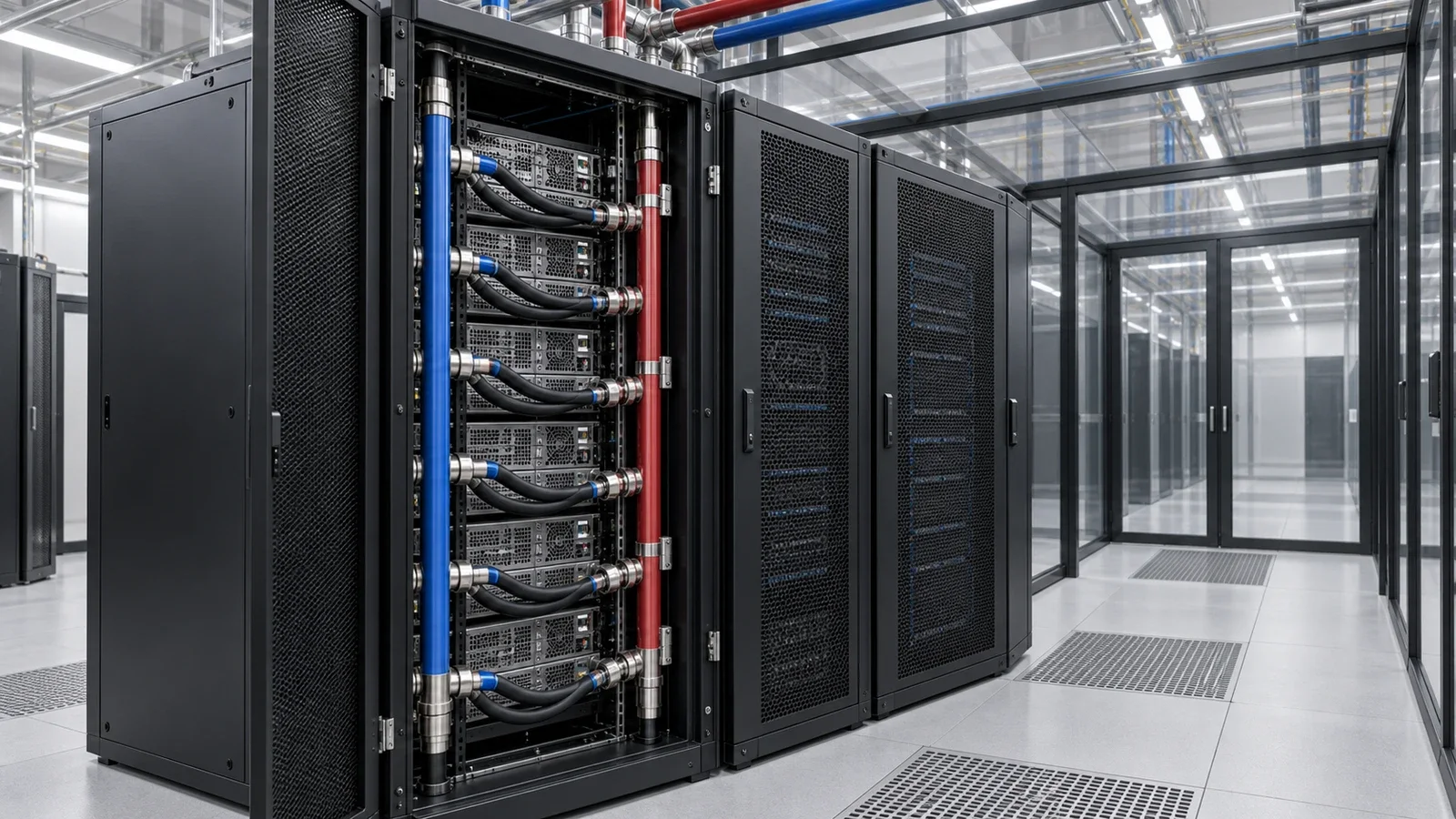
Adding liquid-cooled racks changes where heat goes. It does not, by itself, remove the air-cooling load from a mixed data hall. Where liquid-cooled equipment operates alongside air-cooled servers, the design still needs a clear route for both coolant and exhaust air.
The starting point is the equipment's actual heat split. A coolant distribution unit serves the liquid circuit; any heat released into room air needs a separate removal path. That split depends on the platform and installation. Fully liquid-cooled systems also exist, so a fixed percentage of residual air cooling should not be applied to every rack.
For the air-cooled part of the hall, the familiar problem remains: warm exhaust must not return to equipment inlets. Gaps around racks and incomplete aisle boundaries can undermine the intended supply and return paths. Containment helps separate those air streams. Its layout needs to follow the equipment's airflow direction, with service access and fire-safety requirements retained.
Insulation addresses a different mechanism. Where a solid partition separates warmer and cooler zones, a suitable insulation layer can reduce heat transfer through that partition. It does not seal an open air path or replace a fan, heat exchanger or CDU. Rack sidewalls, aisle walls and modular enclosure panels are potential assessment locations, provided they are not intended ventilation or heat-rejection surfaces.
The useful question is therefore not simply whether a data centre uses liquid cooling. It is which loads remain air-cooled, where the heat should leave, and which boundaries should limit unwanted transfer. Defining those paths first gives containment and passive insulation a precise role, without assuming an efficiency gain before the complete design is assessed.