

Thermal engineers reviewing a thin insulation sample and equipment cross-section

Engineering

Understand the material. Calculate the requirement. Discuss the application.

A concise route from microporous insulation principles to a preliminary material direction for your thermal design.

01

How it works

Three heat-transfer routes. One structure designed to slow them.

A fine-pore matrix acts on solid conduction, gas movement and thermal radiation together, delivering high thermal resistance in a slim insulation layer.

01

Solid conduction

LONG, TORTUOUS SOLID PATH

Limit conduction through the silica network

The highly porous silica network has very small particle contact points. Heat must follow a long, tortuous path through the solid phase, reducing conductive heat flow.

Small contacts. Long heat path.
02

Gas-phase heat transfer

unrestricted molecular pathfineporePORE SIZE < GAS MEAN FREE PATH

Restrict gas movement inside fine pores

The silica network forms pores smaller than the mean free path of air molecules. Molecules repeatedly strike the pore walls instead of travelling freely, reducing gas conduction and suppressing convection.

Fine pores. Restricted molecular travel.
03

Thermal radiation

REFLECTEDABSORBED

Absorb and reflect infrared radiation

Metal-oxide opacifiers dispersed through the silica matrix absorb and reflect infrared energy, limiting radiative heat transfer at elevated temperatures.

Infrared absorption and reflection.
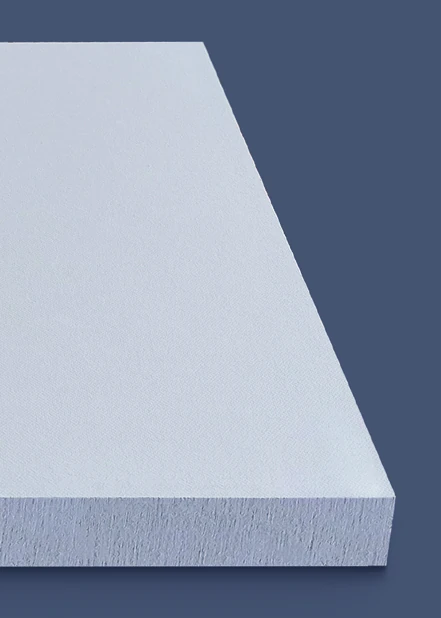
Siltherm microporous core board showing its fine, uniform material structure

Integrated core matrix

The mechanisms work together within the material.

Pyrogenic silica, opacifier and dispersed reinforcing filaments form one core matrix. The formulation can then be converted into rigid, flexible, shaped, covered or vacuum-sealed formats.
Pyrogenic silicaOpacifierDispersed reinforcement

Verified thermal trend

Low conductivity as mean temperature rises.

Grade 1000 microporous core measures 0.022 to 0.034 W/m·K across the stated ASTM C177 mean-temperature points.ASTM C177 · Grade 1000 microporous core specimen · mean temperature
Grade 1000 microporous core thermal conductivityThermal conductivity rises from 0.022 watts per metre kelvin at 200 degrees Celsius mean temperature to 0.034 at 800 degrees Celsius.0.0200.0240.0280.0320.0360.022200°C0.023400°C0.027600°C0.034800°CW/m·KMean temperatureGrade 1000 microporous core thermal conductivityThermal conductivity rises from 0.022 watts per metre kelvin at 200 degrees Celsius mean temperature to 0.034 at 800 degrees Celsius.0.022200°0.023400°0.027600°0.034800°W/m·KMean temperature (°C)

02

Thermal Calculation

Find the right insulation thickness for your application.

Explore insulation thickness, heat loss and surface temperature with Siltherm. Share your application requirements to access calculation tools and product-selection support from our engineering team.

Request tools & calculation supportLeave your work email and application details. A member of our team will contact you with the appropriate tools and calculation support.
Siltherm.ENGINEERING TOOLS
Thermal CalculationExample

Application conditions

GeometryFlat wall
Hot-face temperature500 °C
Ambient temperature25 °C
Insulation thickness40 mm
Surface emissivity0.80
Heat-transfer coefficient8 W/(m²·K)
Insulation layerSiltherm Board 1000

Thermal assessment

Surface temperature44.2 °C
Heat loss254.8 W/m²
Temperature profile
500 °C44.2 °C
Illustrative calculation. Your application and material selection are reviewed with our engineering team.

03

Discuss your application

Start with the conditions that matter to the design.

Share the operating temperature, available space, equipment type and the result you need. A Siltherm specialist can then narrow the material and format options with you.

Discuss your applicationPlease leave confidential drawings and proprietary geometry out of the initial enquiry.