
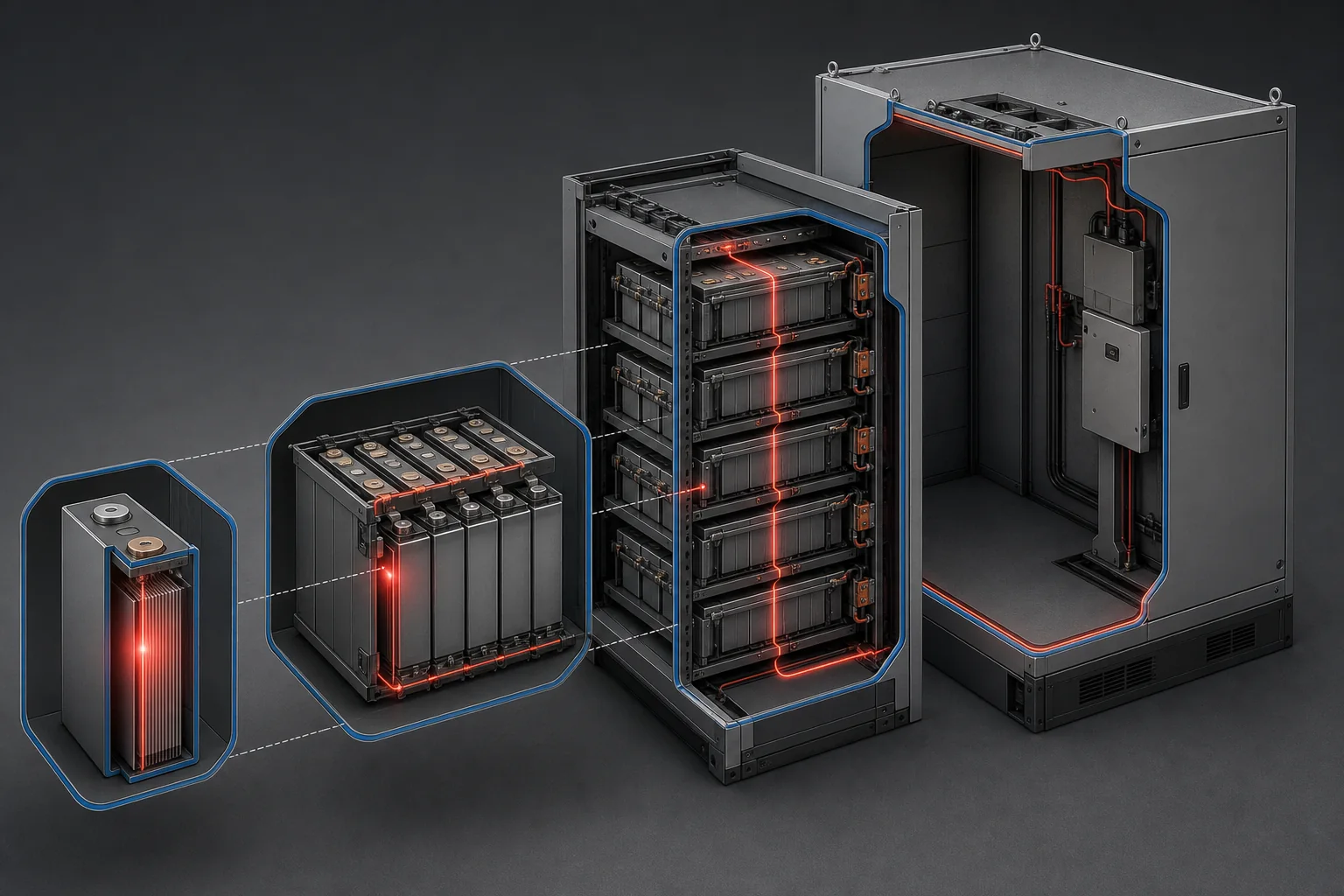
Battery storage brings many energy-bearing components into a confined space. During normal operation, cooling helps manage the heat they produce. A failing cell creates a different problem: neighbouring components may be exposed to intense heat, hot gases and ejected particles. Passive thermal barriers address part of that exposure by placing resistance in the path between a heat source and the component that needs protection.
Where the barrier is placed makes a fundamental difference. A layer between cells addresses an interface close to the source, whereas insulation between modules or along an enclosure wall serves a different boundary. Heat may conduct through contacting surfaces and structural connections, or arrive through a venting path. Blocking a direct conductive route can be useful, but a barrier that leaves the receiving component exposed around its edges may not achieve the intended protection.
This is why a barrier cannot be selected independently of the battery layout. Available thickness, compression and assembly tolerances influence how it fits; restraint influences whether it stays in position during an event. Connections, electrical clearances and pressure-relief routes still need to function. A thin material is valuable when it provides the required resistance without forcing an impractical change to these surrounding features.
The next question is how the arrangement behaves under a representative exposure. Cell chemistry, state of charge and the way a failure is initiated can change the test conditions. Spacing, joints and fixing details can change the response. Material testing helps narrow the choice, while assembly testing establishes what that choice can do in its intended location. Claims about propagation or protection time need to remain tied to those conditions.
Passive insulation consequently belongs within the wider safety design, alongside electrical protection, cooling, detection and the management of vented gases. Its contribution is specific: reducing heat transfer across a defined boundary. Identifying that boundary early gives engineers a clearer basis for choosing the material, developing the installation and collecting evidence relevant to the battery system they are actually building.