Standard product grades1000°C
Primary classification reference across the high-temperature product range.
High-temperature insulation systems
Siltherm combines low-conductivity microporous materials with rigid, flexible and preformed formats for tight backup spaces and difficult equipment geometry.
Classification temperature
Standard grades are classified at 1000°C. Selected higher-grade Board, Board 3D and AluFlex variants are classified at 1050°C.
Primary classification reference across the high-temperature product range.
Listed for selected Board, Board 3D and AluFlex Grade 1100 variants.
Classification temperature is a material reference. The recommended grade still depends on the exposure and the way the insulation is installed.
Space-efficient thermal resistance
Siltherm microporous insulation stays effective as mean temperature rises. In the reference comparison, it reaches the thermal target with less build-up than the selected conventional materials.
As little as one-fifth the thermal conductivity of selected conventional insulators
About half the thermal conductivity of silica aerogel in the reference comparison
The comparison changes with grade and mean temperature. Final thickness is calculated for the installed assembly.
Thermal boundary
Read the heat path from the hot face to the protected shell. That makes the available insulation zone clear before a product form is chosen.
Process temperature and exposure profile
Hot-face material and stored heat
Thermal resistance within the available build-up
External temperature and surrounding interfaces
Product format map
A flat lining may call for a board or panel. Curves and pipework need a format that can follow the equipment without heavy site conversion.
Rigid board
A rigid microporous board available raw or with selected coverings for backup insulation and shaped component routes.
Iron and steel applicationEncapsulated rigid panel
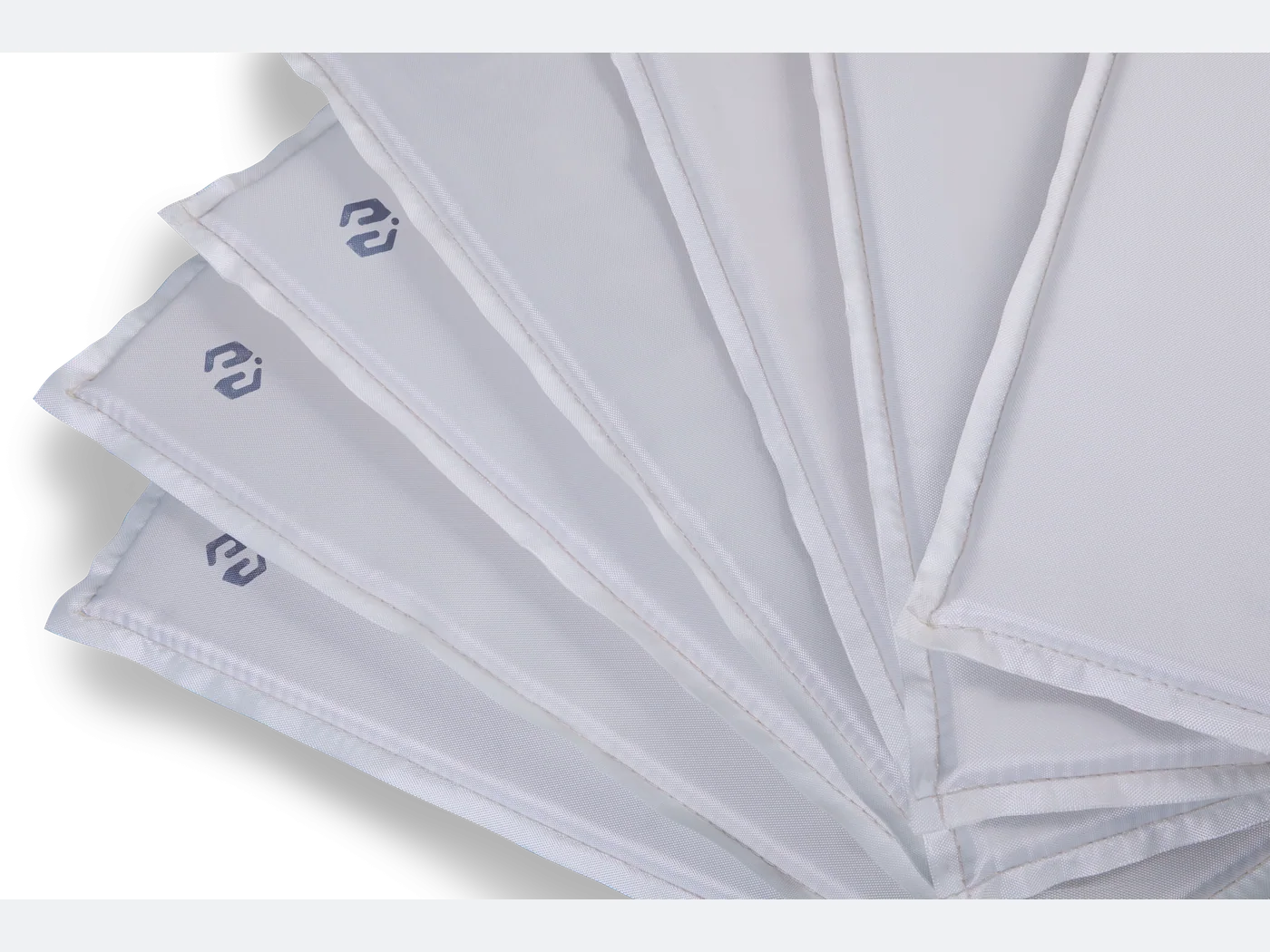
A glass-cloth encapsulated microporous panel developed for handling, cutting and integration into high-temperature equipment.
Stitched flexible panel
Cross-directional stitching allows the microporous layer to follow simple or complex curved geometries.
Iron and steel applicationPreformed rigid section
Preformed microporous sections reduce site shaping around defined pipe diameters and can be configured in layered builds.
Aluminised flexible panel
An aluminised, water-repellent envelope supports clean manipulation where moisture-bearing castables or mortars may be present.
Iron and steel applicationMachinable rigid board
A machining-suitable rigid grade for components that need repeatable geometry and defined surface detail.
Foldable slatted panel
Made-to-measure microporous slats in a glass-cloth envelope allow a larger panel to follow a controlled radius.
Iron and steel applicationStandard dimensions support an initial comparison. Siltherm will confirm the suitable grade and current availability for the application.
Selection sequence
Continuous, cyclic, transient or localised heat?
How much insulation thickness and external space are available?
Flat, curved, segmented, penetrated or irregular?
What compression, covering, fixing and adjacent materials are involved?
Which temperature, test condition and assembly boundary must be validated?
Operating environments
Industry pages place the insulation format inside the heat source, equipment geometry and validation context that determine useful performance.
Technical performance
Thermal data becomes useful when the product grade, test method and mean temperature match the comparison being made.
These details are enough to identify a starting point. Keep confidential drawings and proprietary construction details out of the initial enquiry.
Discuss a high-temperature application