
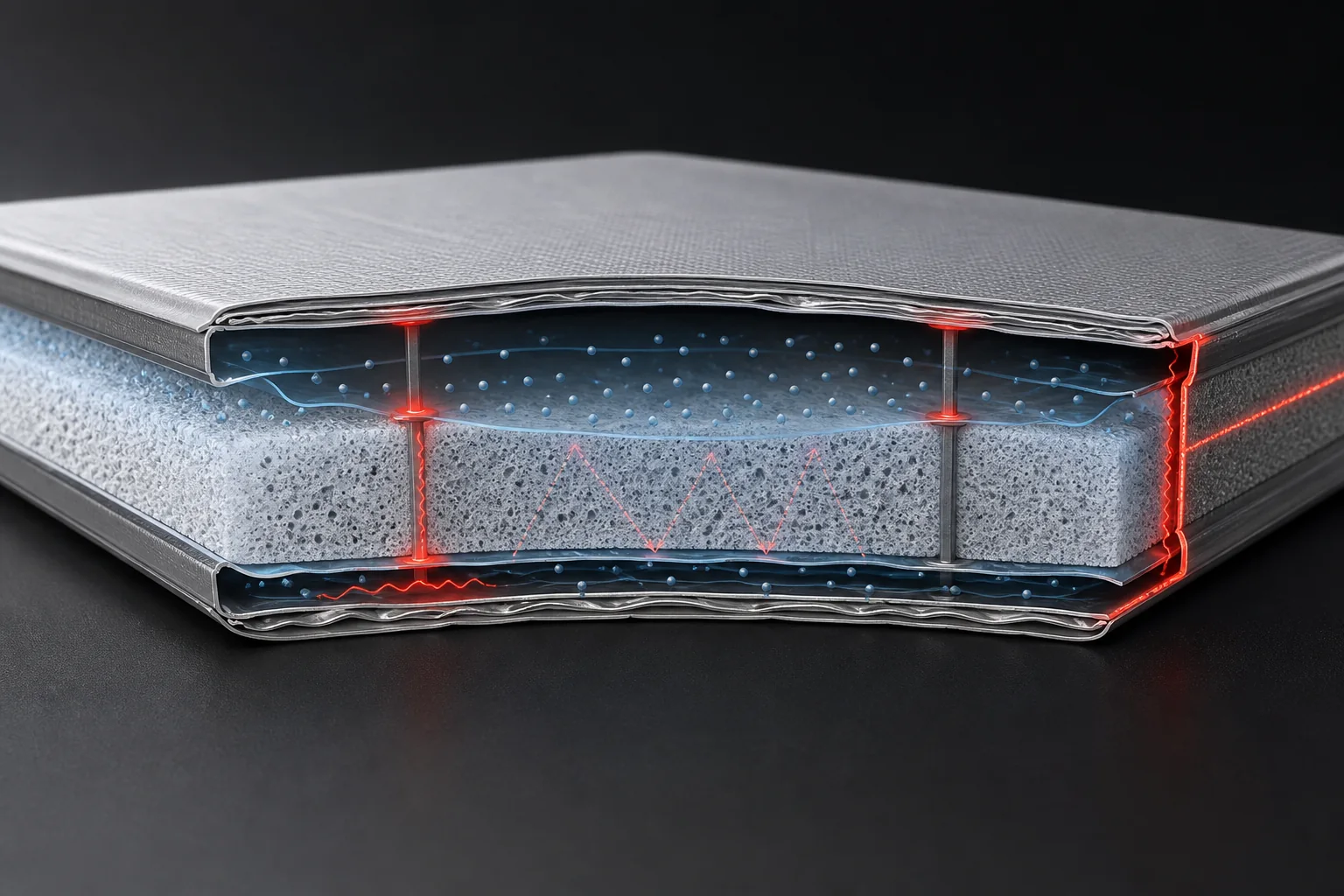
Keeping a temperature-controlled package cold, or adding insulation beneath an existing floor, presents the same practical difficulty: space taken up by insulation is space no longer available for something else. A vacuum insulation panel addresses this by reducing the heat that can pass through each unit of thickness. Its performance comes from the combination of a finely porous core and an envelope that keeps most of the air out, rather than from a hollow space alone.
Air trapped in an ordinary porous material still transfers heat as its molecules exchange energy. Removing much of that gas reduces this contribution. Within a fumed-silica core, the narrow pores further restrict gas-phase heat transfer because molecules encounter the pore walls frequently. Lowering the pressure strengthens this effect. The gas is not completely absent, and the panel does not stop all heat flow, but one important route through the insulation becomes much less effective.
The solid core deals with the remaining routes while supporting the envelope against atmospheric pressure. Its network of particles gives heat a long, indirect path through small contact areas, limiting solid conduction. Opacifying components reduce infrared transmission through absorption and scattering. These mechanisms explain why the core matters even after the panel has been evacuated: a vacuum and a carefully designed material structure perform different, complementary jobs.
Turning that behaviour into useful insulation also depends on keeping the envelope intact. Its barrier properties help maintain the internal pressure, while the sealed perimeter introduces a heat path that differs from the centre of the panel. Joints between panels and surrounding supports add further paths. Consequently, two layouts made with the same core can have different installed thermal performance, particularly when one uses many small panels with a greater total edge length.
For the designer, vacuum insulation is therefore both a material choice and a layout choice. Panel dimensions, edge treatment and protection from puncture should be resolved alongside the required thermal resistance. Used in a planned, protected assembly, the technology offers a way to retain useful internal volume or working clearance without simply making the insulation layer thicker. The relevant measure of success is the heat flow through that finished assembly, not the lowest conductivity number on its own.