
Standard glass-cloth envelope
Supports clean handling, cutting and manipulation around the reviewed geometry.
Stitched flexible microporous panel
Stitched microporous insulation for pipes, curved surfaces and irregular shapes.
Siltherm Quilt places a reinforced microporous core inside a stitched glass-cloth envelope. The stitch pattern lets the panel follow pipes and irregular equipment.
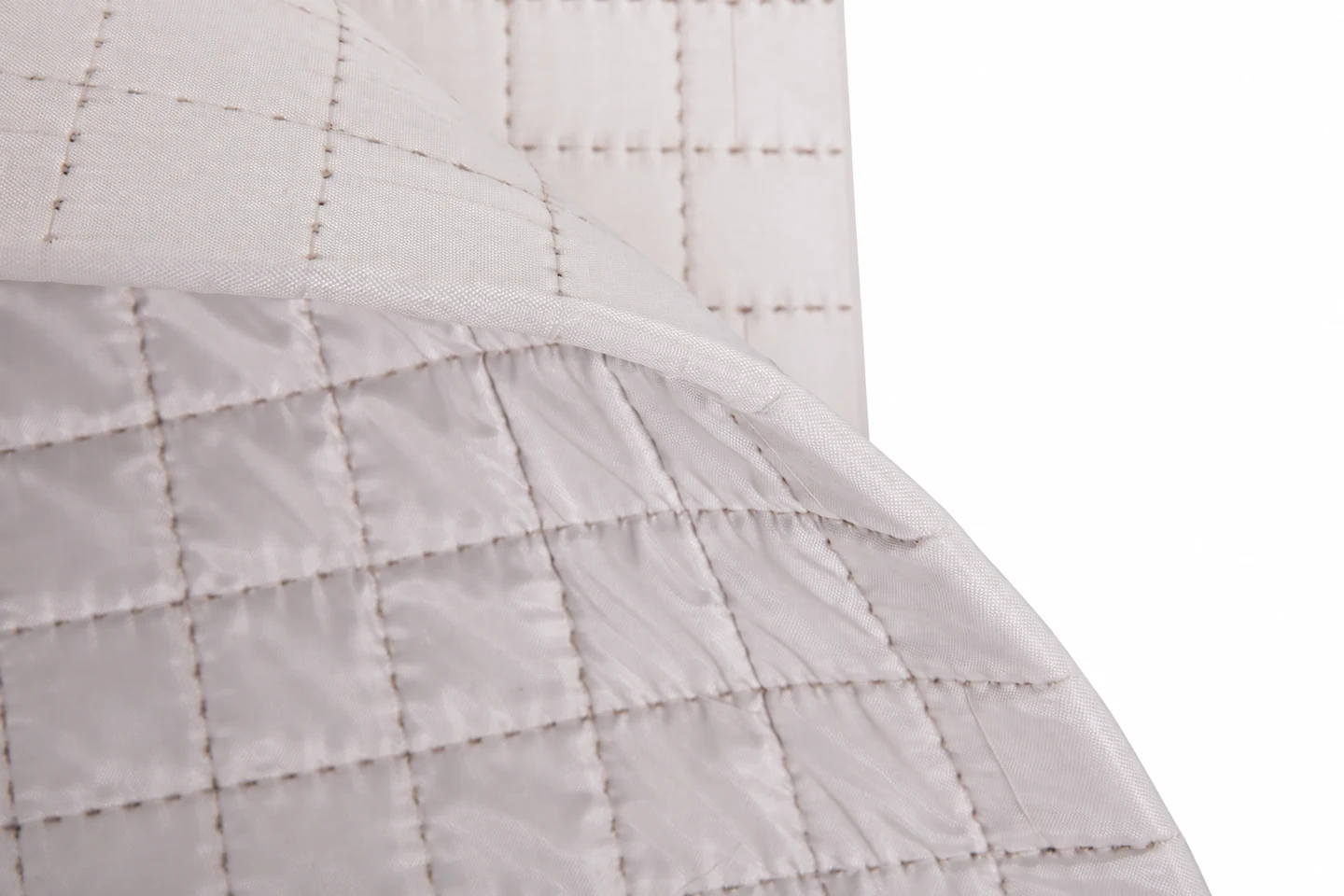
Stitch architecture
The stitch direction controls how the panel bends. One direction suits simple curves; two directions allow more complex shaping.
Parallel stitch lines allow the panel to be manipulated around reviewed pipe and duct geometries while retaining a clean glass-cloth envelope.
Pipe / duct / simple curveAvailable stitching pitches include 25 x 25, 50 x 50 and 100 x 100 mm, with direction and spacing selected to suit the intended geometry and handling needs.
Envelope and moisture boundary
The standard product uses a glass-cloth envelope. A hydrophobic grade is available where moisture exposure needs to be considered.
Supports clean handling, cutting and manipulation around the reviewed geometry.
A grade option for conditions where water or condensation risk belongs in the design brief.
Weatherproofing, drainage, jacketing, joints and inspection remain system-level responsibilities.
A hydrophobic grade is available for applications where moisture exposure is a consideration. The surrounding insulation and protection system should be designed for the actual service conditions.
Cutting, fixing and edge control
Siltherm Quilt can be cut and fixed with conventional methods. Align the stitch direction with the curve before laying out seams and fixing points.
Use a sharp knife or cutter for the reviewed panel geometry.
Align stitch direction with the intended bend, twist and surface transition.
Review glue, retaining pins or anchors, straps, or wire against the assembly.
Seal cut edges with glass-fibre tape or aluminium self-adhesive tape where required.
Geometry-led application routes
Siltherm Quilt is intended for the curved and irregular equipment routes below. Select the grade and stitch pattern for the duty.
Pipes, hot-air routes and concentrated-solar piping where the insulation follows a defined curve.
Hot pipe supports, flexible ball joints and inner cores for reviewed removable jacketing systems.
Tuyere stocks, recuperators, hot-air piping, ducts, pipes, vessels and removable cable-protection cores.
Flexible Quilt formats can follow transportation heat shields, exhaust systems and road-transport vessel surfaces where the geometry and protection arrangement are defined.
Jet-fire systems, barriers, shutters, electric cables, air ducts and curtains remain complete-assembly questions.
Technical documentation
Product grade and stitch pattern are coordinated around the equipment geometry. Jacketing and moisture protection follow the service conditions.
Review the high-temperature systemApplication discussion
Tell us the equipment type, operating temperature and shape. Also let us know whether the insulation must be removable.
Discuss a Quilt applicationDo not include proprietary drawings or confidential construction details in the initial enquiry.