
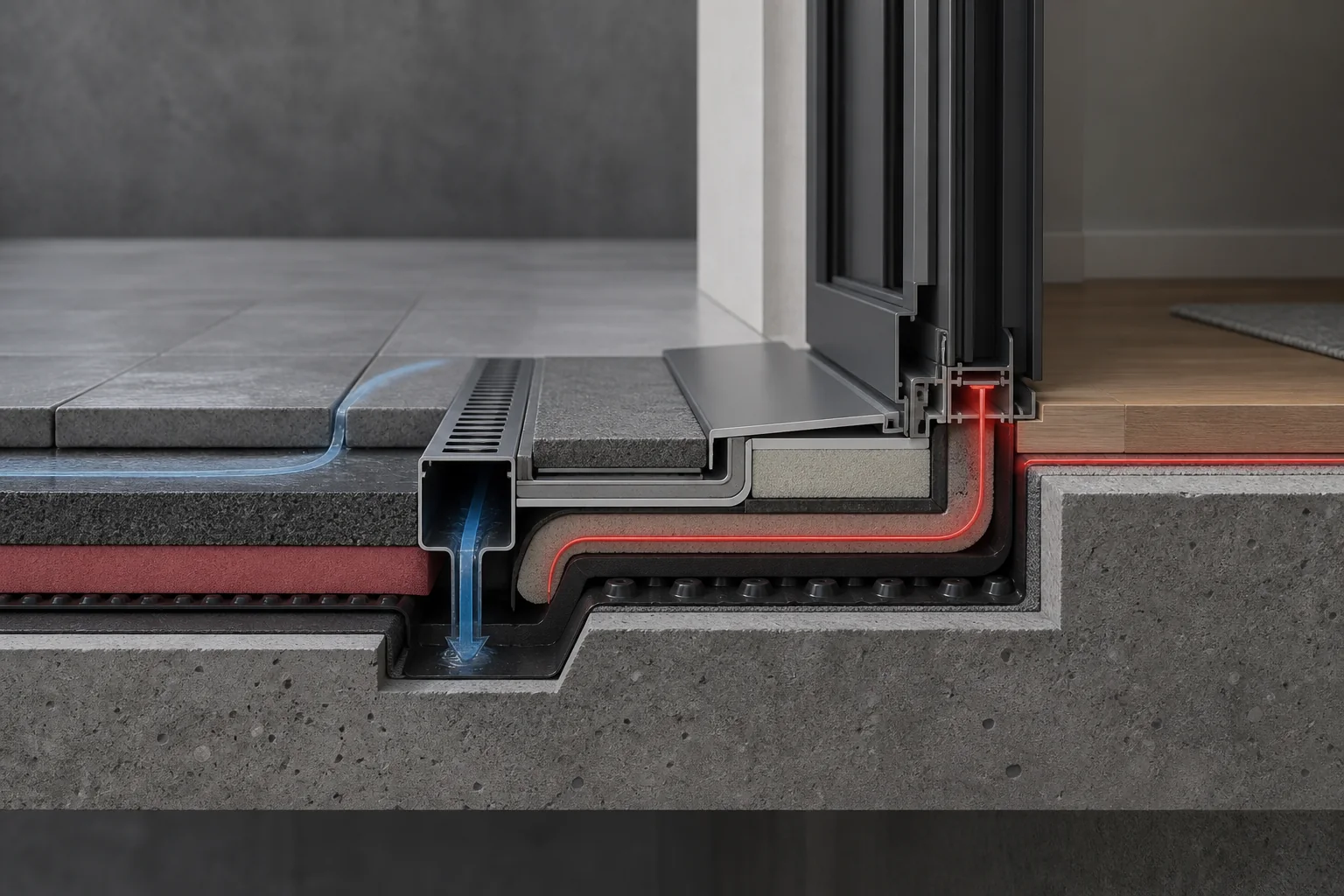
The short distance beneath a terrace door has to accommodate a surprising amount of construction. Insulation, waterproofing, drainage and the walking surface all need space, while the indoor floor and door frame constrain the final levels. A change to one layer can affect several others. This makes the threshold a useful example of why insulation thickness can become an architectural issue as well as a thermal one.
Vacuum insulation panels can reduce the depth needed for the insulation portion of a suitable build-up, leaving more room for the other functions. Their value is especially apparent where raising the outside surface or altering the existing doorway would be difficult. The panel provides thermal resistance; the waterproofing and drainage layers still have to do their own jobs. Saving space in one part of the detail does not remove the need for a continuous water-management design.
A workable proposal therefore develops from the complete section through the doorway. The drainage fall, door-frame connection and supporting structure establish where the panels can sit. Drains, posts and irregular perimeters rarely follow a perfect panel grid, so full-panel areas and supplementary infill need to be coordinated before installation. On-site cutting is not a solution because it opens the vacuum envelope.
Protection then has to follow the sequence of work. Panels should not become an unprotected route for construction traffic, and subsequent fixings must avoid the sealed insulation. The surrounding layers also need to provide the required support and distribute loads as specified for the assembly. These arrangements are part of making a thin panel usable beneath an occupied surface.
The final thermal assessment should include the threshold, frame and perimeter rather than treating the terrace as an uninterrupted sheet of insulation. With those connections resolved, vacuum panels can help reconcile a difficult level difference with the need for thermal resistance. The benefit is a coordinated doorway detail, not simply a thinner product inserted into an unchanged drawing.