
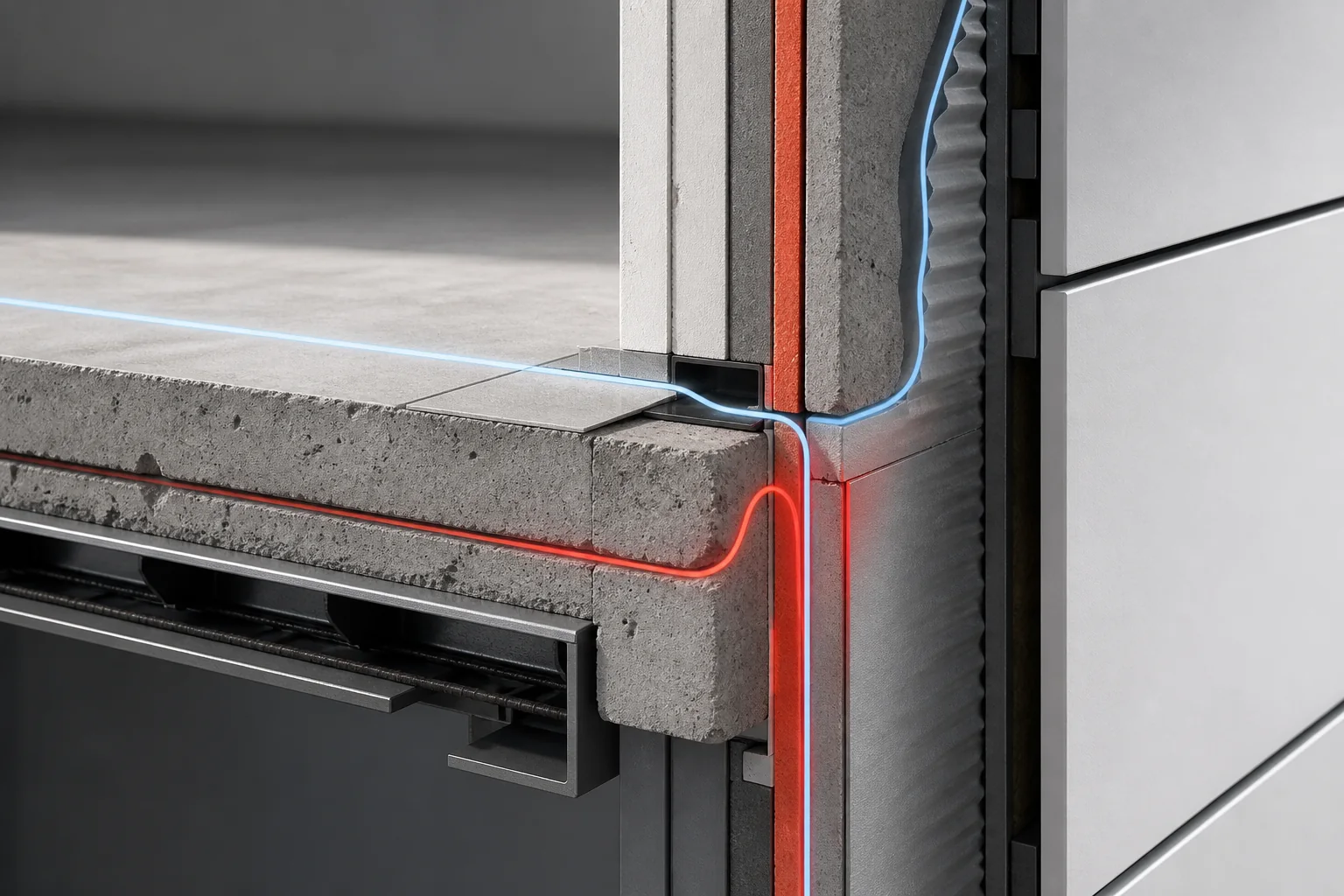
A building detail can contain a good insulation layer and still lose more heat than expected. The difficulty often lies at its edge: a floor meets a wall, a frame interrupts a panel, or a fixing connects across the insulation. These small areas matter because heat follows the available routes through the whole construction, not just the route represented by the main insulation layer.
Increasing the thickness over the broad surface may improve that part of the envelope without resolving the junction. In a constrained detail it can also raise a floor level or leave too little space at a door. The task is to locate the route responsible for the unwanted heat flow and determine how much room is available to improve it. A vacuum panel can be useful when the necessary thermal resistance must fit into that restricted depth, but it does not make adjacent materials thermally invisible.
Panel edges, perimeter infill and structural connections still contribute to the result. A coordinated layout allows the compact insulation to occupy the useful area while keeping unavoidable interruptions visible in the calculation. This detail matters on site too. Vacuum panels cannot be trimmed around an unexpected pipe or pierced for a convenient fixing. Penetrations and tolerance zones need to be planned, and the envelope protected until it is safely enclosed.
Addressing a cold edge therefore begins with understanding the junction, not searching for a material that solves every weakness. Thin insulation offers another option where space limits the repair. Its value becomes clear when the complete detail is assessed, including surface temperatures and moisture considerations where relevant, and the improvement can be built without leaving the original heat path untouched.